

Mechanical Engineering
Program Type
B.S.
Est. Time to Complete
4 Years
School
Kinsley School of Engineering, Sciences and Technology
Delivery Mode
On Campus
See your ideas come to life as a mechanical engineer.
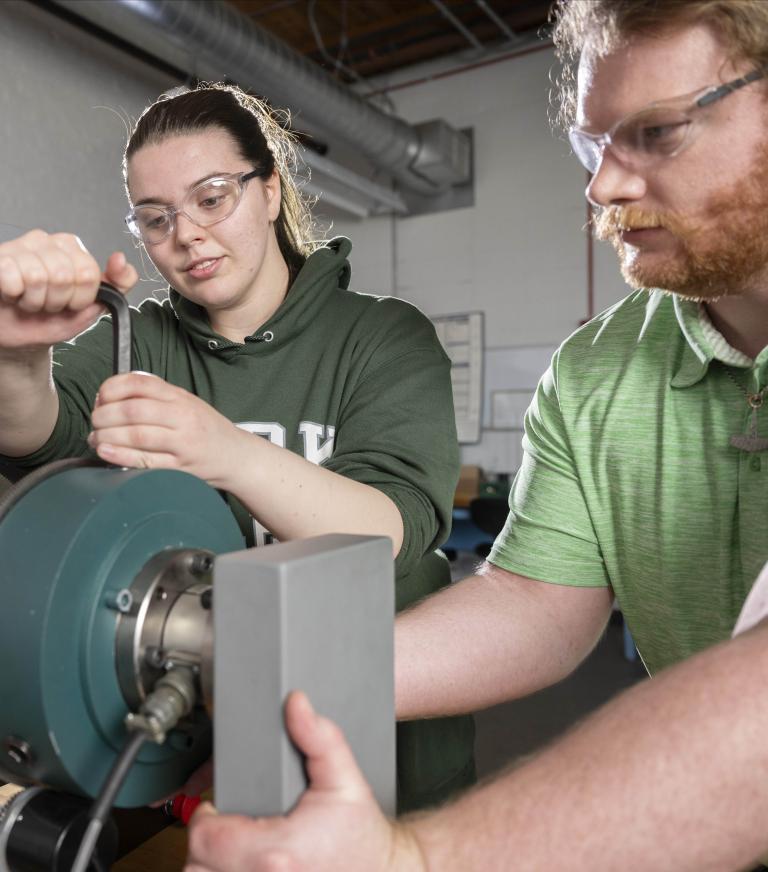
Mechanical engineers design, build, and improve the machines, systems, and devices that power our world. In York College of Pennsylvania’s ABET-accredited Bachelor of Science (B.S.) in Mechanical Engineering degree program, you’ll apply what you learn right away through hands-on projects in your first year.
Gain paid, real-world experience across the country with a two-semester co-op. Recent graduates have used their skills to create innovative automotive systems, drones, and automation technologies that solve real-world challenges and advance industries, including energy and healthcare.
About the B.S. in Mechanical Engineering
Program Curriculum
Every course in York’s Mechanical Engineering program emphasizes hands-on, project-based learning. You’ll explore the art of engineering design, learn the physical and digital tools used across industries, and build the critical thinking and communication skills employers and graduate programs value.
Requirements include:
- General education and first-year seminar
- Core major courses
- Engineering elective(s)
- Math or science elective(s)
- Design capstone
- Cooperative work experience (Co-op)
Hands-On Learning
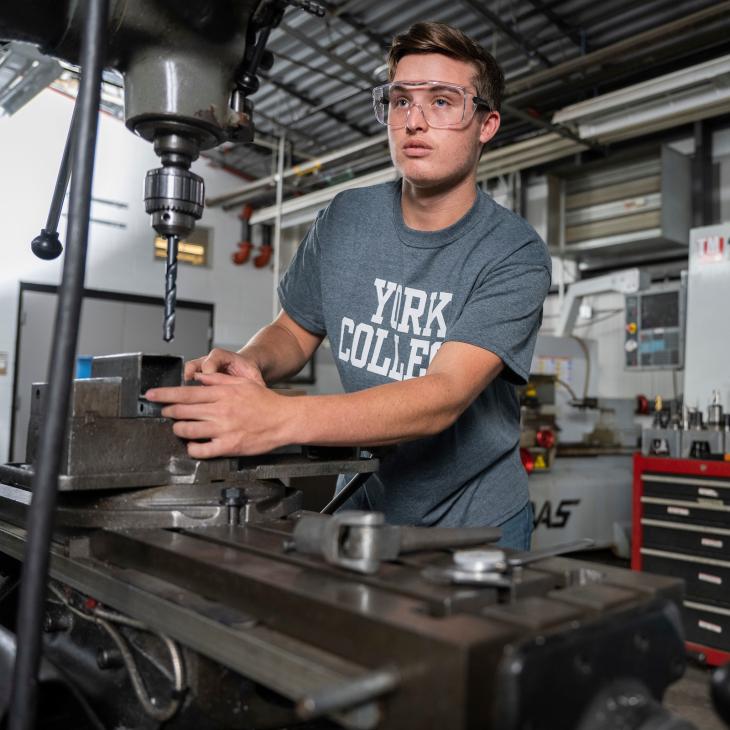
Recent investments in technology—such as a new 3D metal printer in the Kinsley Engineering Center—make it possible to see your designs come to life from concept to prototype.
The ABET-accredited Mechanical Engineering program also requires applied work experience in the form of a co-op, helping you graduate with up to one year of real engineering training.
Admissions Requirements
To apply for the B.S. in Mechanical Engineering program at York College of Pennsylvania, you’ll need:
- A completed York College application (no separate engineering application required)
- High school transcript with strong performance in math and science
- SAT or ACT scores (optional)
- Personal statement or essay (recommended)
- Letters of recommendation (optional)
View complete admissions information and request information to get started.
Salary and Outcomes
According to the Bureau of Labor Statistics (BLS), mechanical engineers make a median annual salary of $102,320. Mechanical Engineering majors from York College of Pennsylvania have gone on to work at top employers, including:
- American Hydro
- Harley-Davidson
- Johnson Controls
- RMF Engineering
- Teleflex
- United Technologies
Mechanical Engineering Careers
Mechanical Engineering majors are prepared for high-demand careers in many industries: hydropower, medical devices, automotive, aerospace, and more. Career options to pursue after majoring in Mechanical Engineering include:
- Aerospace Engineering
- Advanced Manufacturing Facilities
- Automation Controls and Instrumentation Design
- Equipment Design and Production
- Energy Production
- Forensic Engineering
- Hydropower Engineering
- Industrial Engineering
- Materials Characterization and Engineering
- Product Research and Development
- Process Engineering
- Polymer Engineering
More experience means more specialized jobs and achieving licensure can open doors for higher earnings. Most licenses, like a Professional Engineering (PE) license or state license, require about four years of experience.
Salary ranges can also be higher for engineers in high-demand fields, like energy.
Pathways to Graduate School
In addition to preparing you for entry-level engineering roles, the research and design experience of our Mechanical Engineering program (like from ME 380: Machine Design) can help you qualify for graduate studies. A graduate degree, like a master’s or Ph.D., can lead to advanced engineering roles or academic research careers at colleges and research institutions.
The scientific background embedded in the B.S. in Mechanical Engineering degree can also prepare you for graduate studies in business, law, medicine, and other fields. This can open doors to interdisciplinary areas like bioengineering, patent or intellectual property law, and many other career paths.
Mechanical Engineering Co-Op
Our built-in engineering co-op experience lets you graduate with a year of real work experience. After two years in the B.S. in Mechanical Engineering program, you'll alternate academic semesters with paid employment under top employers, gaining degree credit and a deeper understanding of the profession.
If you have previous engineering experience, you may be qualified to waive a co-op semester.
Research and Design Capstone
Faculty advisors supervise capstone and research projects, refining both technical skills with theoretical knowledge. As a Mechanical Engineering major, you’ll go deeper into specific research questions through a final capstone and optional independent study courses, building, testing, and applying design principles.
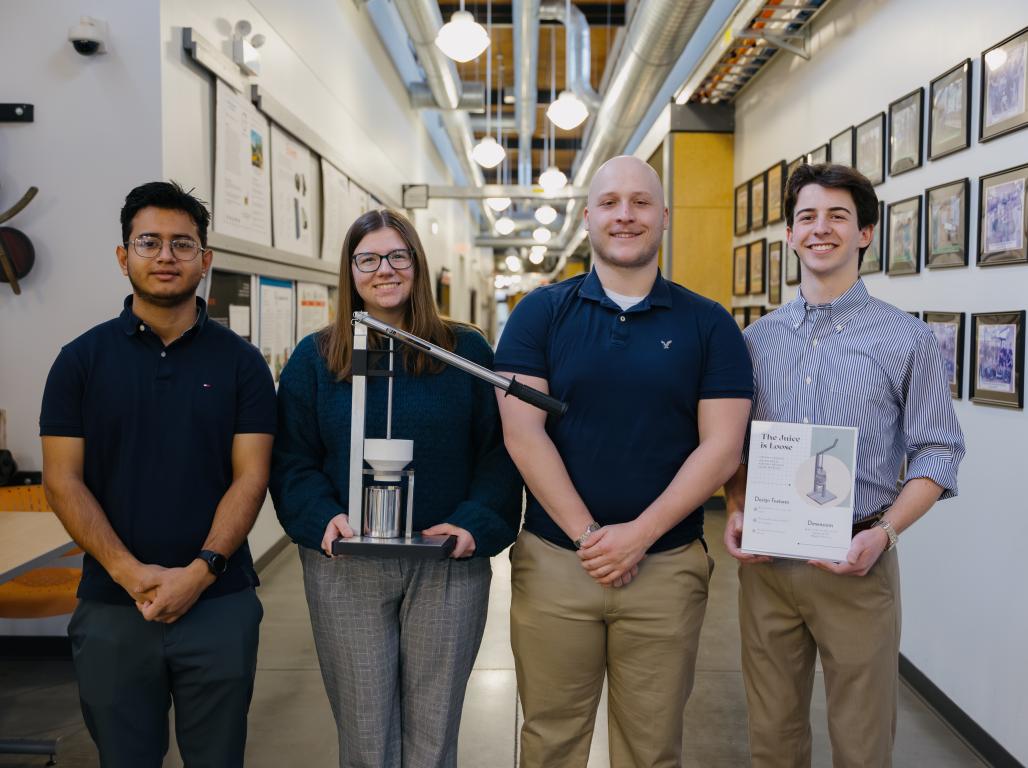
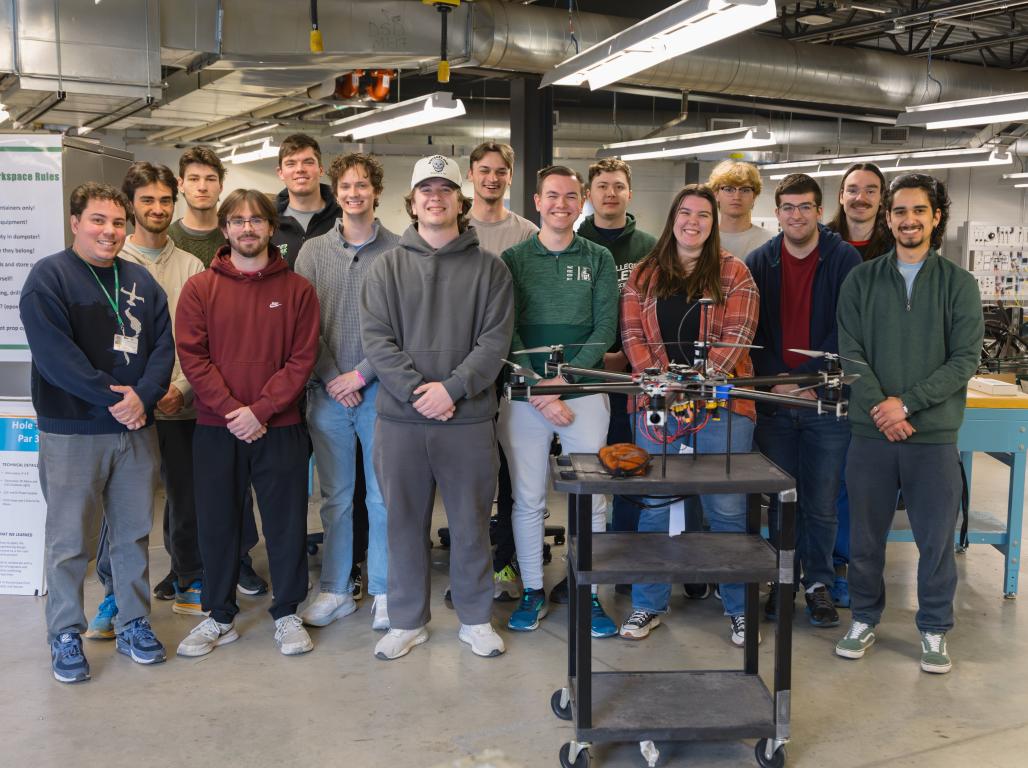
In a two-part capstone design project (ME 400 and ME 402), you’ll create a prototype device or system–students have automated greenhouse and bike rental systems, designed race cars and drones, and developed innovative workplace technologies.
These projects solve real-world problems by integrating research with practical engineering skills learned in courses like Applied Mechanics and Materials and Applied Kinematics and Dynamics.
Collaborative Facilities
Our on-campus engineering facilities offer practical experience in various subfields. Our weld and wood shops in the Kinsley Engineering Center are great places to practice safety protocols. Plus, learn specialized skills with our visualization lab, 3-D projection system, and computer labs catering to automation, robotics, power systems, energy conversion, materials engineering, embedded systems, and thermodynamics.
Expert Faculty
Faculty in the Kinsley School of Engineering, Science, and Technology have extensive professional and academic experience. They will support you throughout your research and capstone projects, offering insights from various disciplines.
Instructors share their interdisciplinary expertise (fluid dynamics, civil engineering, mechanics, and more) in the classroom and during independent study. They help you learn state-of-the-art lab technology and collaborate with you on your research.
Clubs and Organizations
Beyond engaging with expert faculty, students in the Mechanical Engineering B.S. program also build connections with peers and leading professionals through student clubs and organizations. Engineering-specific organizations include:
- American Society of Mechanical Engineers
- Women in Science and Engineering
By earning your bachelor’s in Mechanical Engineering at York College of Pennsylvania, you’ll learn to:
- Solve complex problems using advanced math and engineering principles
- Use engineering machinery and modeling, and design software
- Design experiments, analyze data, and communicate technical results
- Integrate environmental, social, and economic factors into decision-making
- Continue learning and adapting as technology evolves.
Adding a minor can also add high-demand skills that employers look for:
ABET-Accredited Mechanical Engineering Program

The Mechanical Engineering B.S. program is accredited by the Engineering Accreditation Commission of ABET, https://www.abet.org, under the General Criteria and the Program Criteria for Mechanical and Similarly Named Engineering Programs.
ABET is a nonprofit, non-governmental agency that accredits programs in applied and natural science, computing, engineering, and engineering technology. ABET accreditation provides assurance that a college or university program meets the quality standards of the profession for which that program prepares graduates.
Mechanical Engineering Courses
Your class schedule will include core courses for your major, Gen Next general education classes, and electives.
| Course Name | Course Code | Credits |
|---|---|---|
| Mathematical Methods in Engineering | EGR 240 | 3 Credits |
| Strength of Materials | EGR 264 | 4 Credits |
| System Modeling and Analysis | EGR 342 | 3 Credits |
| Fluid Mechanics | EGR 360 | 3 Credits |
| Thermo/Fluids Experiments | ME 361 | 1 Credits |
| Machine Design | ME 380 | 4 Credits |
Careers in Mechanical Engineering
A bachelor’s degree in Mechanical Engineering opens up a variety of career opportunities. Some of your options may include:
Advanced Manufacturing Engineer
Instrumentation Designer
Forensic Engineer
Mechanical Engineer
Product Development Engineer
Polymer Engineer

Build your dream career, one day at a time.
This is day one. From your first semester on campus through graduation day, York College offers expert advice, professional development opportunities, and personalized support to help you navigate the choices that influence your future.
Explore resources for a successful college experience:
Frequently Asked Questions
From HVAC systems to robotics, mechanical engineers tackle diverse challenges across a wide range of specializations. Regardless of industry, their core function is to solve problems by conceptualizing and developing mechanical systems. Their work includes computer-aided design, constructing and testing prototypes, and overseeing manufacturing processes.
Your work location may vary, too. Mechanical engineers often work in office settings and may even be able to work from home some days, but mechanical engineers also may be called to the field (such as a worksite or factory) to troubleshoot issues, observe the system or design in use, or perform repairs.
Full-time students can earn their bachelor’s degree in mechanical engineering in four years, allowing them to enter the workforce or pursue further education or training. Up to four additional years of work experience are typically required to move beyond entry-level positions and earn licensure as a Professional Engineer.
According to the BLS, mechanical engineering careers are growing much faster than the average for all professions. Additionally, a bachelor’s degree in Mechanical Engineering offers design knowledge and technological skills applicable to many engineering fields. In-demand careers, such as industrial, electrical, and aerospace engineering, benefit from this background.
Mechanical engineering is one of the most versatile and in-demand engineering disciplines. It offers a strong foundation in problem-solving, innovation, and technical design—skills that translate to countless career paths or graduate programs.
While electrical engineers focus on circuits and systems, and civil engineers design infrastructure, mechanical engineers bridge physical design and motion. They apply physics, thermodynamics, and materials science to create machines and systems used across industries.
York College offers a range of scholarships, grants, and financial aid for qualified students, including merit-based awards and need-based assistance. Mechanical Engineering majors may also qualify for STEM-specific scholarships and paid co-op positions that help offset tuition costs.
Meet the Faculty
View All Faculty



Mechanical Engineering in Action
View All News
Related Programs
Civil Engineering
The Bachelor of Science (BS) in Civil Engineering degree program at York College of Pennsylvania is the first step in a career with a meaningful daily impact on the everyday lives of people across the globe. Position yourself at the forefront of creating and maintaining the physical frameworks of our communities, such as roads, bridges, airports, tunnels, dams, and essential water and sanitation systems.
Electrical Engineering
Electrical engineers use mathematics and science to design devices, systems, and processes. They work in every industrial and technological sector. These include power generation, manufacturing, robotics, smart grids, and renewable energy.
Engineering Management
What if you could have the perfect blend of business management savvy and technological expertise? The Engineering Management major at York College combines these desirable skills into one degree.