

Get paid as you gain professional experience.
Through the Engineering Co-Op Program in the Kinsley School of Engineering, Sciences and Technology, you'll gain practical hands-on experience with industry employers. You'll graduate with a wealth of real-world engineering experience — and many of our students go on to find employment with their co-op host company after completing their degree.
After your first two years of coursework, you will complete two alternating semesters of co-ops. These are typically paid work experiences, with students acting as temporary employees for industry partners. Through the co-op process, you'll develop job-searching skills by identifying, applying for, and interviewing for co-op positions with companies in South Central Pennsylvania and nationwide.
Co-Op Opportunities and Benefits
All York College engineering students are required to take two co-op semesters. These experiences provide tremendous value. They prepare students for more advanced coursework, while also offering insights into career options and real-world workplaces.
Connect the Dots
You'll gain a better understanding of the ways your coursework applies to engineering practice.
Professionalism
Co-ops provide opportunities to hone the skill set of a working professional, including interpersonal and communication skills.
Get Paid for Your Work
Earn money with paid co-op positions that help you meet college expenses.
Build Your Network
Learn about your future profession by connecting directly with practicing engineers.
Ready Your Résumé
With two semesters of industry work experience, you'll have an edge in the job market upon graduation.
Receive Meaningful Feedback
You'll receive an evaluation from your co-op supervisor, offering feedback you can use as you move forward in your career.

Student FAQ
| Year | Fall | Spring | Summer |
| 1st Year | Academic Term | Academic Term | * |
| 2nd Year | Academic Term | Academic Term | CO-OP I |
| 3rd Year | Academic Term | CO-OP II | * |
| 4th Year | Academic Term | Academic Term | May Graduation |
*Students have the option to complete experiential learning opportunities.
Computer, Electrical, and Mechanical Engineering students must meet the following requirements:
- You must maintain a GPA of at least 2.5
- You must satisfactorily complete a minimum of 64 credit hours towards your engineering major
Civil, Computer, Electrical, and Mechanical Engineering students must also meet the following requirement:
- Satisfactorily complete EGR 290, Engineering Career Training seminar, a course designed to support the engineering career preparation and improve employment skills.
- Each co-op experience must last a minimum of 12 weeks in the summer and a minimum of 15 weeks in the spring or fall, if applicable
- Vacation time does not count toward the total number of weeks worked
- Work weeks must be full-time (40 hours per week or similar, per company policy)
- Part-time work does not count toward a co-op
While it is your responsibility to find a co-op position, the Engineering Co-op Program Director will assist students in their co-op search by:
- Helping you with resume writing and interview skills
- Posting positions from local employers
- Scheduling on-campus interviews
- Hosting events on campus where you can meet with industry professionals to learn and network
Or you may find your own co-op position. Co-op job descriptions must be approved by the faculty program coordinator.
Prior to obtaining a co-op position, you are responsible for the following:
- Ensuring that you meet all the eligibility requirements for the co-op program.
- Obtaining an appropriate co-op position.
- Registering for each co-op period with the College Registrar and paying the required tuition for co-op credits.
- Completing a resume critique and mock interview with the engineering co-op program director by the deadline.
- Following appropriate interview procedures: notifying employers of late arrival or cancellation of interviews, arriving on time for interviews, and sending personal thank-you notes following an interview.
- Advising the Engineering Co-op Program Director(s) of all interviews, offers, and accepted employment.
- Notifying engineering faculty and co-op director(s) of your starting date, employment location, supervisor email address and telephone number through submission of the Accepted Co-Op Form.
As a co-op engineer in the workplace, you will be responsible for:
- Reporting to work in a timely manner.
- Dressing appropriately for the position you have obtained.
- Completing work assignments in a timely and thorough fashion.
- Seeking the advice of your supervisor or mentor if you have any questions regarding work assignments.
- Communicating regularly with your supervisor and keeping him/her up to date on the progress of each assigned project.
At the completion of each co-op term, you will also be responsible for ensuring that:
- The co-op evaluation surveys must be completed and submitted electronically.
- A poster must be completed and submitted to your co-op advisor for approval.
The exact duties and functions you will have in the workplace will vary with the employer, your abilities and skills, and the co-op term you are in. You will always be assigned to work with a practicing engineer, who will provide guidance and direction for your work assignments. Some examples of potential job functions are:
- Testing of both standard and developmental products or building materials, concrete, soils, water, etc.
- Analyzing test data using statistical methods
- Conducting engineering analysis using thermodynamic, static, dynamic, and vibration analysis, etc.
- Performing engineering design utilizing CAD
- Conducting experiments to assist in the design of products or processes
- Writing operating or processing instructions
- Purchasing, installing and starting up equipment
- Assisting on job sites with project management tasks
Co-op wage scales and benefits are set by individual employers in accordance with current market conditions.
The successful co-op experience is a combination of the job assignments provided by the employer and what you are willing to put into the experience. The goal is for the employer to provide each student with significantly challenging engineering work that truly complements the rigor of his/her academic program and for you to work on each assignment and complete it in the manner that your employer has described to you. Not all assignments will be fun and technically challenging. However, as you complete each one you will be able to show your employer that you have the ability to complete more technically challenging assignments.
There are several ways in which you will receive feedback during your co-op work experience.
- Your co-op faculty advisor will visit your workplace where he/she will meet with both you and your assigned mentor to determine if there are any concerns that need to be addressed.
- At the end of your co-op term both you and your employer will fill out an evaluation survey, which will be returned to your advisor. This information is confidential between the student, the advisor and the employer.
Not necessarily. However, in order to ensure that you are receiving maximum benefit from your co-op experience and that the key factors for success (described above) are met, it sometimes makes sense that you maintain employment with the same organization throughout your co-op experience. This, in turn, places more responsibility on the faculty advisor to know something about your career goals and abilities, and to help steer you toward a suitable and appropriate co-op experience.
It should be noted, however, that this is not required, and in many instances it is an advantage for you to have co-op experiences with more than one company. Moreover, there is no guarantee that you will be asked to return to the same organization at which you previously worked. This is determined to a large degree on a case-by-case basis.
No. You are free to choose any geographic location for co-op and are encouraged to seek co-op opportunities abroad with U.S.-based companies that carry out international engineering operations.
Locally, an organization of more than 20 companies (the EIAC) advises and supports the development of the engineering program, and provides co-op employment opportunities for York College engineering students. Students who co-op locally have the option to use York College housing during their co-op periods, during which time standard room charges apply.
Yes. The successful co-op experience is based upon the three-way interaction involving you, your employer-based engineering mentor, and your co-op faculty advisor.
During your co-op semesters, this interaction is nurtured and documented through regular meetings with your engineering mentor, on-site visits by your co-op faculty advisor, written assessments and evaluations by both mentor and advisor, and through your own co-op report and written evaluation of your co-op work experience.
Hear From Our Students
During his co-op at NASA Johnson Space Center in Houston, Josh Polanchek worked with the Engineering Simulation and Robotics Division to help develop new astronaut training technology. His project focused on creating a proof-of-concept training system that combined virtual reality with physical mock devices, allowing users to interact with realistic equipment while immersed in a VR environment. The goal was to make astronaut spacewalk training more interactive and hands-on than traditional simulations.
Josh designed and built prototype hardware using sensors, microcontrollers, and 3D-printed components. He worked on integrating motion tracking and feedback systems so the physical devices could communicate with the VR software in real time. In addition to building and testing prototypes, he collaborated with engineers across multiple disciplines and presented his work to members of NASA’s XR Interest Group.
Through this experience, Josh gained practical skills in mechanical design, CAD, programming, electronics integration, and rapid prototyping. He also strengthened his problem-solving and communication abilities while working on a project that combined hardware, software, and immersive technology.
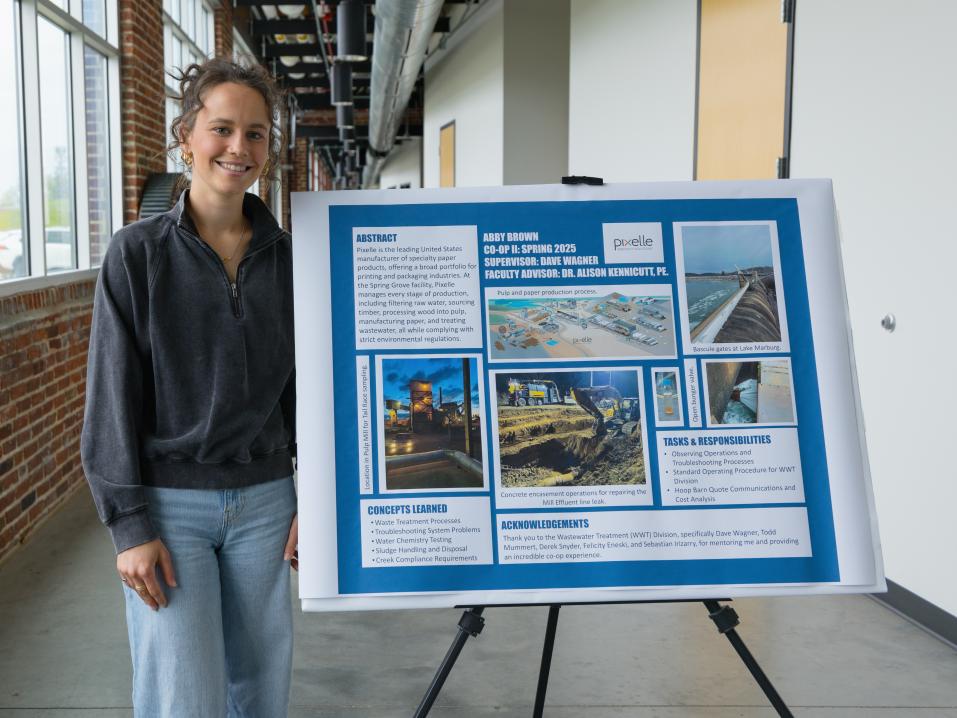
Abby completed her co-op at Pixelle, the leading U.S. manufacturer of specialty paper products, at their Spring Grove facility. The plant handles every stage of paper production, from sourcing timber and processing wood into pulp all the way through manufacturing and wastewater treatment.
Abby worked within the Wastewater Treatment (WWT) Division, where her responsibilities included observing and troubleshooting operations, developing standard operating procedures, and handling cost analysis and quote communications for a Hoop Barn project. She also got hands-on experience in the field, including work related to a concrete encasement repair of a mill effluent line leak and water sampling at the facility.
Through her co-op, Abby built a strong foundation in environmental and industrial engineering concepts, including waste treatment processes, water chemistry testing, sludge handling and disposal, and creek compliance requirements.
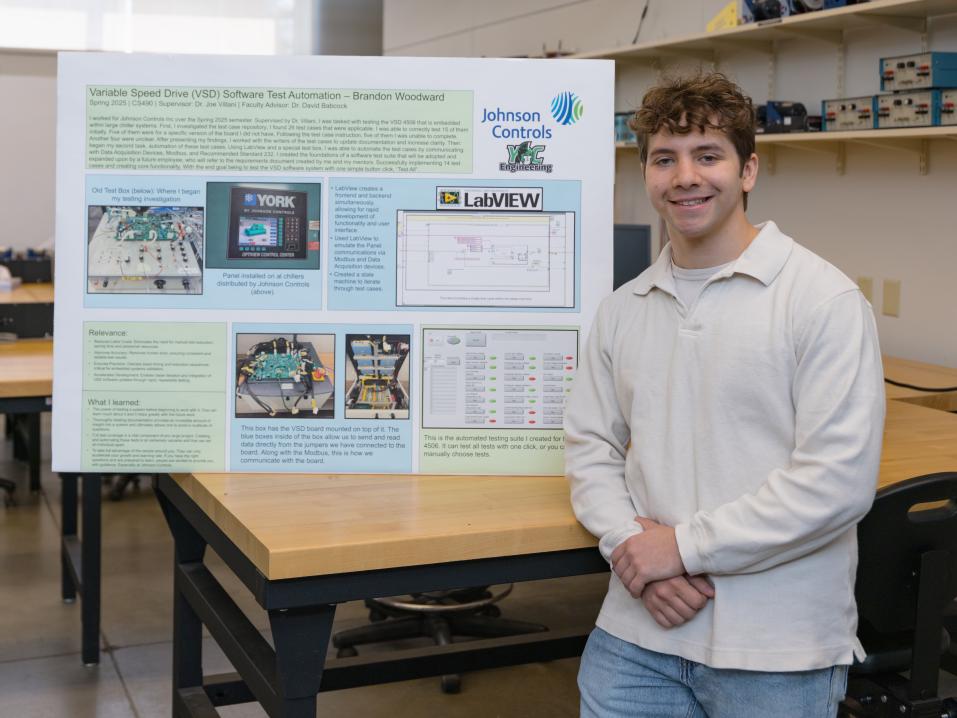
Brandon spent his co-op at Johnson Controls International, a global technology company specializing in building systems and industrial equipment. He worked on software testing for components used in large industrial chiller systems. His work focused on making the testing process faster, more reliable, and easier to repeat.
He started by reviewing existing test cases, figuring out which ones were usable, and working directly with the people who wrote them to clean up confusing or incomplete documentation. From there, he moved into building an automated testing system, which allowed the software to communicate directly with hardware components. By the end of his co-op, he had automated 14 test cases and laid the groundwork for a system where engineers could eventually run all tests with a single click.
Brandon picked up a range of practical skills along the way, including test automation, hardware and software integration, technical documentation, and debugging. His work directly reduced the time and manual effort required to validate the software, while also making results more consistent by removing the chance for human error in repeated tests. His performance during the internship earned him a return offer for a full-time position.
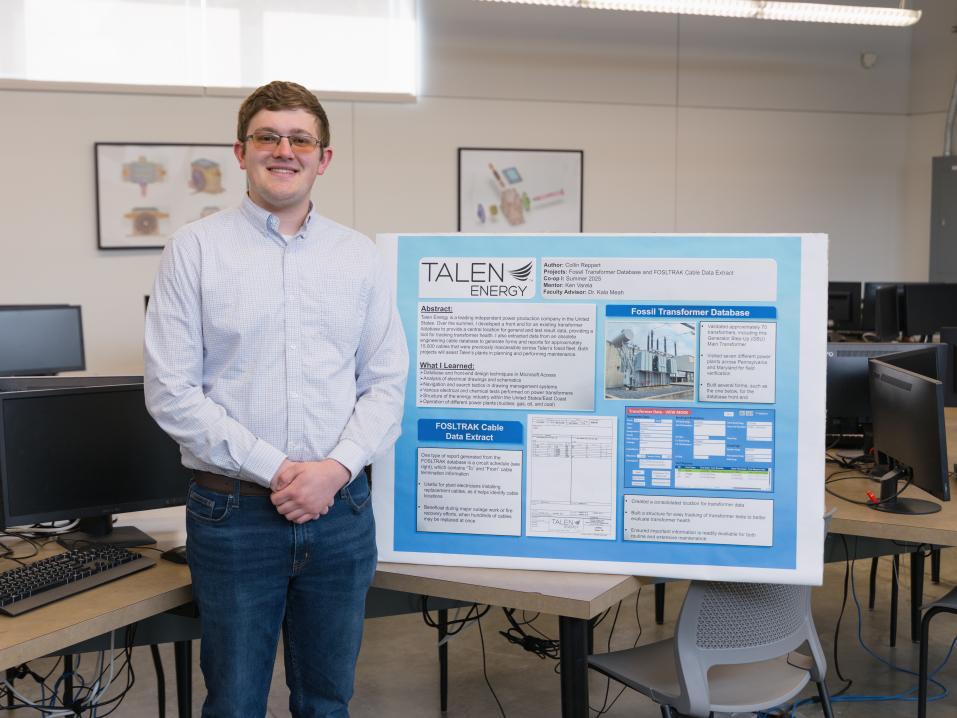
Collin completed his co-op at Talen Energy, a leading independent power production company in the United States, working as an Electrical Engineer Intern. His primary project involved building a front end for an existing transformer database in Microsoft Access to help Talen's plants plan and perform maintenance more effectively.
His days alternated between office work at Talen's corporate headquarters and field visits to seven power plants across Pennsylvania and Maryland to verify data. He developed the database in stages, regularly reviewing his progress with a team of engineers to gather feedback and make improvements. The finished tool gives plant workers a central location to track transformer health and access important information for both routine and major maintenance.
Through this experience, Collin learned the value of being open to input from multiple engineers and balancing office and field work to get the best results. He also gained a broad understanding of how different types of power plants operate, including nuclear, gas, oil, and coal facilities.
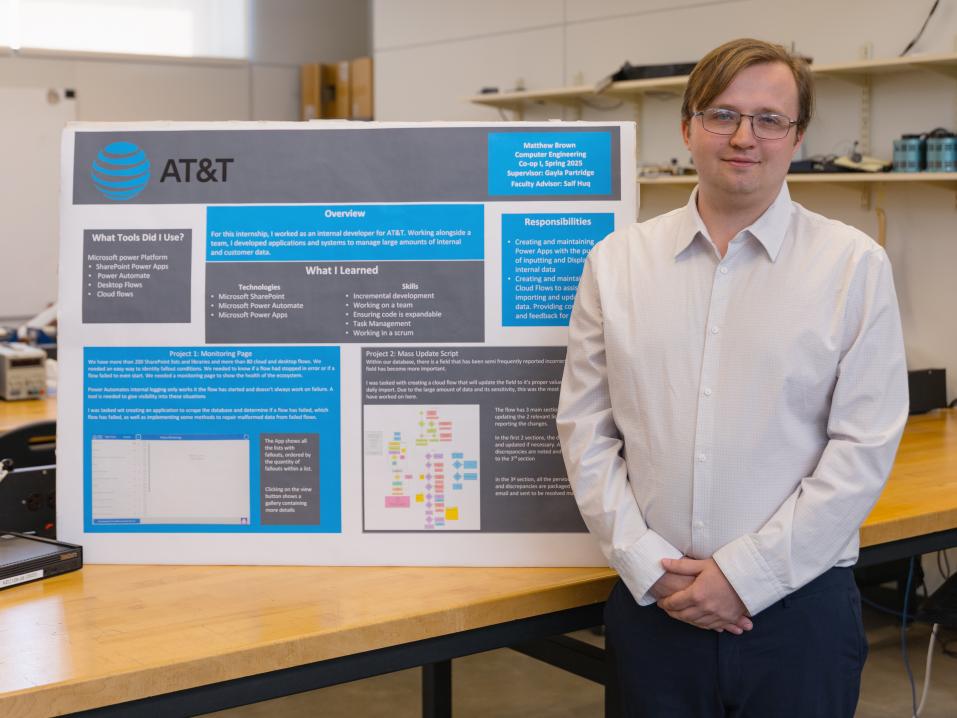
Matthew spent his co-op working as a developer at AT&T, one of the largest telecommunications companies in the country. His job was to build and improve internal software tools that help AT&T employees manage and organize huge amounts of data.
One of his biggest projects was creating a dashboard that monitored over 200 data lists and 80 automated flows at once, alerting the team when something went wrong. He also built an automated system that could pull in fresh data every day, check it for errors, and update company records automatically, work that previously had to be done by hand.
Matthew worked alongside professional engineers using a method called Agile, which is a popular way that real-world tech teams organize their work into short, focused sprints. Along the way, he picked up valuable skills in app development, workflow automation, and managing large-scale data, all tools and techniques used every day in the tech industry.
Information for Co-Op Employers
York College partners with local, regional, and nationwide employers to provide co-operative work experiences for engineering students. Employers benefit from access to well-trained entry-level employees, as well as the support of York College's professional staff and faculty.
Contact Us
Engineering Co-Operative Program
Kelly Arcieri
Engineering Co-op Program Director
Kinsley School of Engineering, Sciences and Technology
Phone: 717.815.1733
karcieri@ycp.edu